
Hospitality
For service industries such as hospitality, artificial intelligence (AI) should not be regarded as simply another tool. It is an enabler: it transforms existing technology, works hand in hand with robotics and automation, and drives the creation of new, purpose-built solutions. How AI is applied, however, varies considerably from one hotel segment to another.
Budget hotels have every incentive to adopt AI that lowers operating costs. Luxury hotels are more selective, using AI where it enhances the guest experience or removes repetitive tasks, without diminishing the personal interaction that remains their key competitive advantage. In the same way, city hotels may prioritise automated arrival for speed and efficiency, while beach resorts and retreats keep their focus on personalised experiences and integrate AI with care.
Personalisation through machine learning. Today’s travellers expect experiences tailored to them, and machine-learning tools that analyse large volumes of data are well suited to the task. By studying booking history, preferences and demographic data, hoteliers can shape marketing campaigns around tailored amenities, room upgrades or suggested activities. If a returning guest regularly books spa treatments or enjoys fine dining, for example, the system can offer a spa and dinner package at a favourable rate when the stay is booked. Guests are more satisfied, and ancillary revenue grows through well-targeted upselling and cross-selling.
Virtual assistants. AI-powered chatbots act as multilingual personal assistants around the clock, handling routine requests such as booking enquiries, recommendations and in-room dining. Examples include “Edward” at the Radisson Blu Edwardian in London and Marriott’s “ChatBotlr”.
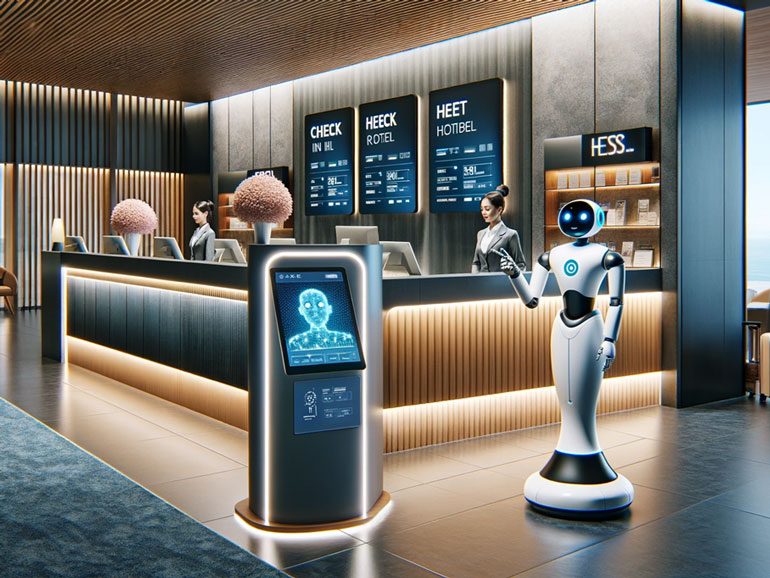
Contactless check-in. Facial recognition combined with AI allows guests to check in seamlessly through a mobile app, a kiosk or a facial scanner. The system verifies identity and reservation details automatically and sends a digital room key to the guest’s phone, shortening waiting times and physical contact. Hotels in China and Japan were early adopters, gaining efficiency while strengthening guest privacy and security.
Smart rooms. AI is shaping a new generation of guest rooms that adjust lighting, temperature and entertainment to each guest’s preferences. Voice assistants such as Amazon Alexa for Hospitality or Google Assistant let guests control the room, request services and access entertainment. Over time, these systems can learn preferences across stays and properties, delivering a consistently personal experience.
Service robots. Forward-thinking hotels are trialling AI-equipped robots for guest-facing tasks: escorting guests to their rooms, delivering amenities or sharing information about local attractions. Examples include YOTEL’s luggage robot “Yobot”, Savioke’s delivery robot “Relay” and Japan’s Henn na Hotel, which is partly staffed by robots. While luxury hotels keep human interaction as a mark of distinction, mid-market hotels are embracing robots for efficiency and a touch of novelty.
Revenue management and dynamic pricing. AI is transforming revenue management, replacing traditional seasonal rates with dynamic pricing. By analysing real-time market data, competitor rates, weather forecasts and local events, systems such as Duetto and IDeaS adjust room rates continuously to optimise occupancy and profitability, reducing manual errors and lifting revenue potential.
Demand forecasting. Predictive analytics allow hotels to forecast demand from historical booking data, economic trends and sentiment on social media. More accurate forecasts help hotels refine marketing, staffing and maintenance planning, leading to greater efficiency and stronger financial results.
Guest feedback. Using natural language processing, AI reads guest reviews and social media posts in real time and identifies patterns of complaint or praise. Hotels can then resolve issues promptly, recognise high-performing staff and keep refining service standards to protect the reputation of the brand.
Marketing. AI enables more precise audience segmentation and behavioural prediction. By analysing website behaviour, booking history and engagement, campaigns can be highly personalised, raising conversion rates and the return on advertising spend.
Housekeeping and maintenance. AI increasingly streamlines housekeeping and engineering. It can track room status and check-out times to plan cleaning schedules, and anticipate equipment failure so that maintenance is carried out before problems arise. In larger hotels, vacuum robots and linen-delivery robots are improving speed and consistency while easing physical workloads.
AI is not a passing trend but the beginning of a fundamental shift in hotel operations. It can raise operational efficiency, improve financial performance and elevate the guest experience through greater convenience and personalisation.
Adoption nonetheless brings challenges: high upfront investment, the complexity of training staff, concerns over data privacy and fears of job losses must all be managed carefully. Successful operators will balance the efficiency of AI with the human touch that defines genuine hospitality.
In the long term, as AI becomes more context-aware and fully integrated, and is adopted thoughtfully, it will help hoteliers drive growth, stand apart and deliver exceptional service in a fast-changing market.

